The Art of Hand Finishing
Buttonholes, pick stitching, and sleeve heads — the handwork details that separate a bespoke suit from everything else. Inside the L&S workshop process.
The difference between a machine-made suit and a handmade one is not always visible from across the room. It reveals itself in the details — the slight irregularity of a hand-sewn buttonhole, the soft roll of a lapel shaped by steam and pad stitching rather than by a press, the way a sleeve hangs from the shoulder with a gentle fullness that no factory can replicate. These are the marks of hand finishing, and they are what elevate a bespoke suit from a well-fitted garment to something genuinely alive.
At L&S Custom Tailors, hand finishing is not an upgrade or an option. It is standard practice on every garment that leaves our workshop. The buttonholes are sewn by hand. The lapels are pick-stitched by hand. The sleeve heads are set by hand. This is time-consuming work — a single jacket can require eight to ten hours of hand-finishing labor after the machine construction is complete — but it is also what separates a bespoke garment from everything else. The hand is visible in the finished product, and the hand is what you are paying for.
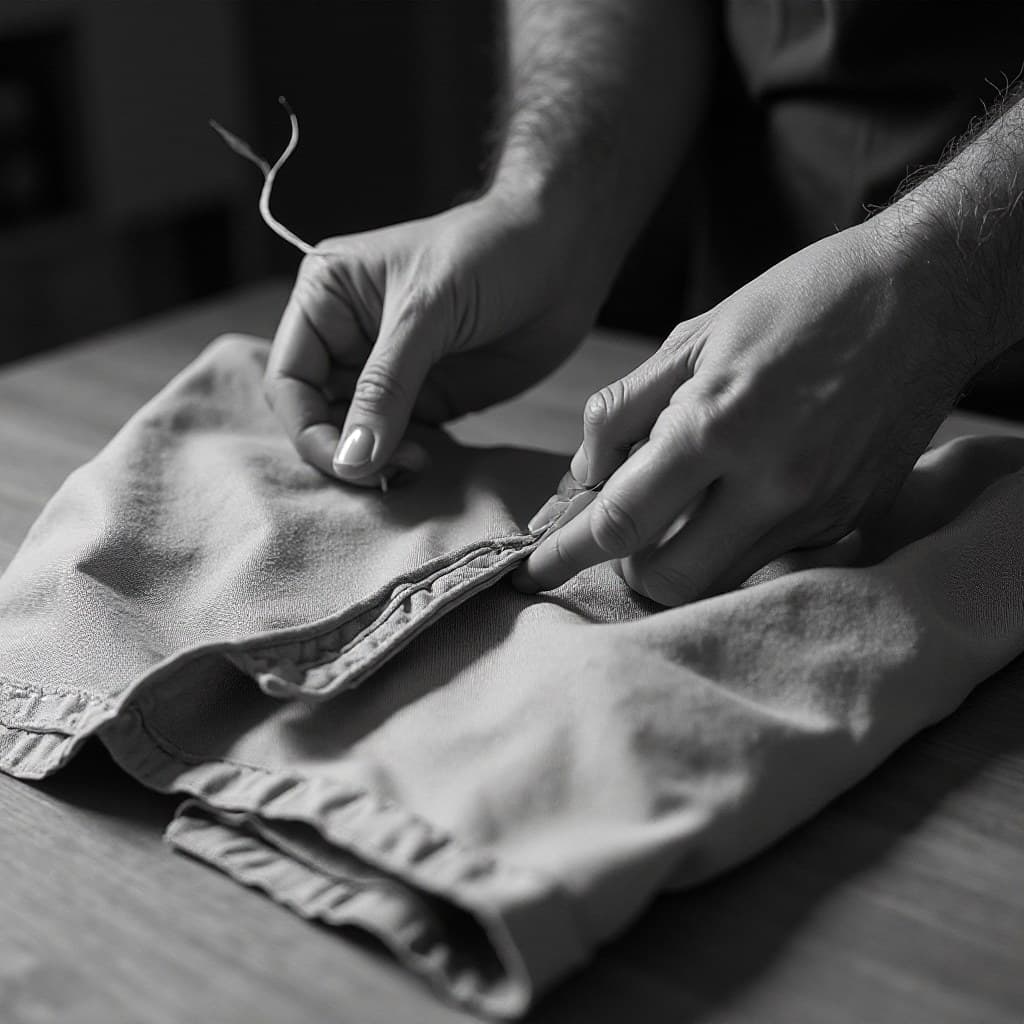
The Hand-Sewn Buttonhole
The buttonhole is perhaps the most telling detail. A machine-made buttonhole is perfectly uniform, stitched in a fraction of a second by a programmable head. A hand-sewn buttonhole takes between fifteen and twenty minutes to complete, with each stitch of gimp-wrapped silk placed individually and pulled to a consistent tension. The result has a subtle three-dimensionality that a machine cannot achieve — a raised, corded edge that is both more beautiful and more durable than its machine-made counterpart.
At L&S, every buttonhole on every garment is sewn by hand, including the non-functional sleeve buttons that many tailors skip. The non-functional buttons — sometimes called surgeon's cuffs — are a detail that matters disproportionately. Most clients will never unbutton them. But the presence of real, working buttonholes at the cuff is a signal that the garment was made by someone who cares about correctness even in places that do not show. It is one of dozens of small decisions that, in aggregate, define the character of a house.
Why Hand Buttonholes Last Longer
Hand-sewn buttonholes are also more durable. A machine buttonhole is stitched through the face fabric and a narrow strip of reinforcement, creating a single plane of attachment. A hand buttonhole is stitched through the face fabric, an interlining, and a backing fabric, with each stitch catching all three layers and pulling them together into a unified structure. The result is a buttonhole that will not fray, will not pull loose, and will not degrade even after decades of use. We have clients who bring us jackets from the 1980s and 1990s for relining, and the buttonholes are still perfect.
Pick Stitching
Pick stitching — the row of tiny, evenly spaced stitches that runs along the edge of the lapel and sometimes around the pockets and front edge — is another signature of handwork. Its purpose is partly structural: it helps the seam allowance lie flat and reinforces the edge of the cloth. But it is also decorative, a quiet signal that the garment was assembled by a person and not a production line.
We use a fine silk thread, usually in a tone that matches the cloth so closely that the stitching is visible only on close inspection. It is not meant to shout. It is meant to reward attention. A client who is familiar with bespoke tailoring will look at the edge of a lapel to see if it is pick-stitched. That glance — and the recognition that follows — is part of the value of the garment. It is a mark of membership in a club that does not advertise itself.
The Sleeve Head
The sleeve head is a detail that almost no one outside the trade ever thinks about, yet it has an enormous effect on how a jacket looks. The sleeve head is a strip of wadding — at L&S, we use a combination of lambswool and cotton domette — that is inserted at the top of the sleeve where it meets the shoulder. Its job is to support the fabric as it transitions from the shoulder line into the sleeve, creating a smooth, rounded crown without any dimpling or collapsing.
Setting a sleeve head properly requires the tailor to ease the fabric by hand, distributing the fullness evenly so that the sleeve falls in a clean, natural line. It is one of the most technically demanding steps in jacket construction, and one of the most satisfying to get right. A well-set sleeve head gives the jacket a fullness at the shoulder that reads as natural rather than padded — a quality that is central to the Sicilian soft-shoulder tradition we practice at L&S. A poorly set sleeve head, or a sleeve set without any head at all, produces a flat, lifeless shoulder that looks exactly like what it is: a factory garment.
Why Hand Finishing Matters
The cumulative effect of these details — the hand-sewn buttonholes, the pick stitching, the carefully set sleeve heads, the pad-stitched lapels, the hand-attached linings — is a garment that looks and feels different from anything produced on a line. It is not necessarily more formal. It is not necessarily more expensive-looking, in the flashy sense. It is simply more correct. The proportions are right. The finishing is clean. The details reward close inspection. When you commission a bespoke suit from L&S, you are paying for precision in the cut and quality in the cloth, but you are also paying for this level of finishing. It is what makes the garment worth keeping for twenty years.
Experience It Yourself
Book a consultation at our East 61st Street workshop and discover the difference that fifty years of craft can make.
Book a Consultation